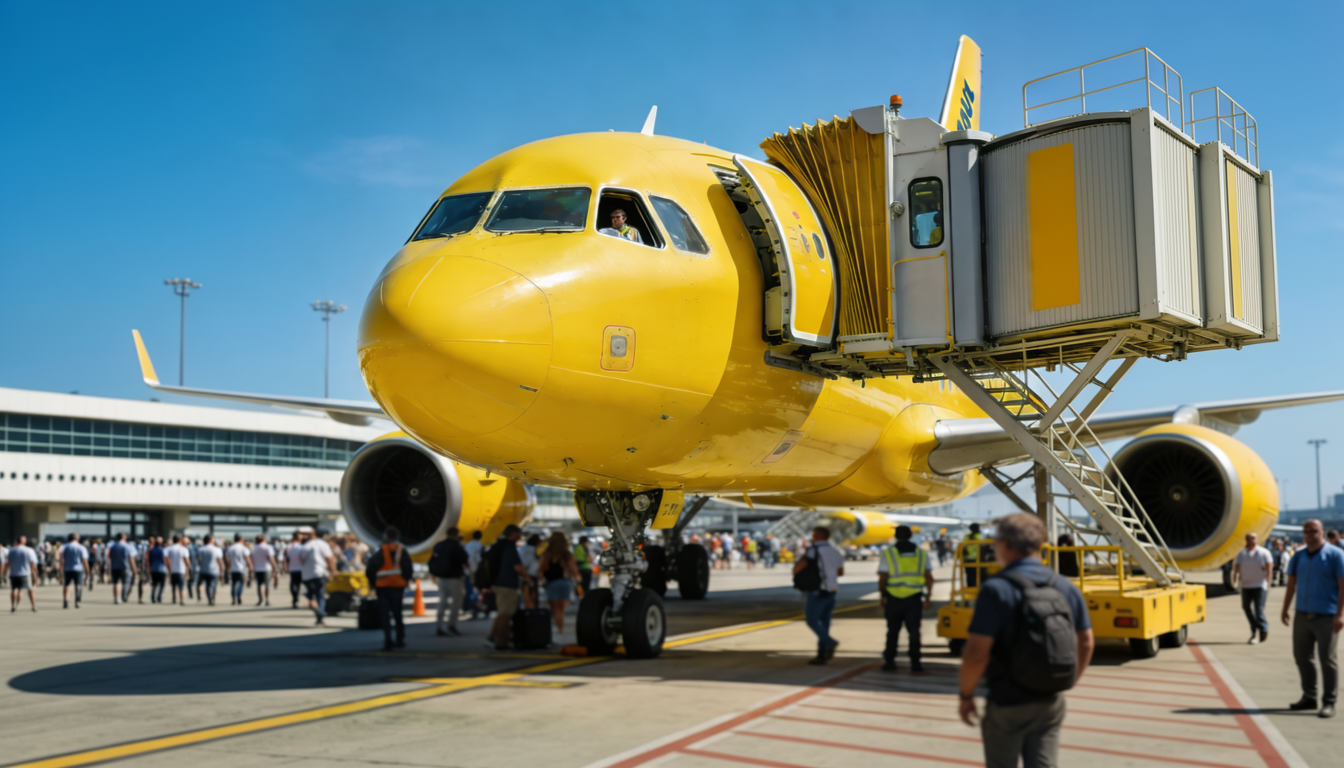
Why Lacking Spirit Will Be the Downfall of Spirit
As the U.S. government weighs a rescue for Spirit Airlines, it should consider Warren Buffett’s famous quip: the quickest way to become a millionaire is to start with a billion dollars and buy an airline.
Spirit’s well-chronicled struggles raise a fundamental question: should the government protect failing carriers, or let the market prune those that cannot sustain themselves? More importantly, what enables an airline to remain resilient amid global economic turbulence?
For communications advisors, Spirit’s crisis is a masterclass in what happens when a brand loses its narrative before its balance sheet. By the time a company is in court, the reputational damage is often already done.
The crisis at Spirit proves that "Price" is no longer a sufficient differentiator. In the 1990s, Spirit pioneered the "Ultra-Low-Cost Carrier" (ULCC) model, stripping away every amenity to offer "bare fares." Today, that model is broken in the US.
Spirit’s strategic drift is also a communications failure. For years, the brand made price its entire identity – and communicated nothing else. When that identity became untenable, there was no second narrative to fall back on.
Rising labor costs, fuel spikes, and engine maintenance issues have eroded the price gap. Simultaneously, Delta and United have weaponized "Basic Economy" to compete on cost while offering superior reliability. Spirit has been squeezed in no-man’s land.
The ongoing high fuel price has escalated US aviation issues and prompted other discount airlines to approach the US government now, asking for $2.5 billion of support to tide them over.
In a brutal sector, lasting survival requires something that cannot be manufactured: spirit and loyalty.
Sir Richard Branson’s Virgin Atlantic has proved the gold standard for resilience over its 40 years. With only 43 planes, Virgin consistently punches above its weight. Recognizing he couldn’t out-market British Airways, he decided to beat them on soul. He transformed flying from a chore into an event, introducing onboard bars, luxury lounges and "Upper Class" cabins that felt like private clubs.
Richard understood that an airline’s true product is its people. By empowering staff to show personality, Virgin fostered a tribal loyalty that a balance sheet cannot truly reflect. As the "underdog," he used irreverent wit to poke fun at his rival and boost his brand.
When BA struggled to erect the London Eye, Virgin flew a blimp over the site with the slogan: "BA Can’t Get It Up!" Stunts like this humanized the brand and won market share that traditional advertising never could.
What Richard understood instinctively, and what communications professionals know well, is that brands are built in the space between campaigns. The London Eye blimp wasn’t a marketing stunt; it generated earned coverage no paid budget could have bought. Virgin’s real competitive weapon was its ability to control the narrative.
In contrast, the ghosts of U.S. aviation, Pan Am, TWA, and Eastern, fell victim to commoditization. They engaged in a "race to the bottom" on price, losing their identity in the process. Without a unique brand or a truly unbeatable cost structure, they were caught in the middle: high costs and a low-value perception – and ended up bankrupt.
Each of those carriers suffered a communications crisis that both preceded and accelerated their financial problems. By competing only on price, these brands failed to create true loyalty – so when turbulence hit, they lacked the reputational capital needed to retain customers and weather the storm.
Today, there are only two clear routes to success. Delta and United have chosen the premium path, investing in new fleets and network reliability to attract the high-value traveler. Their CEOs Ed Bastian and Scott Kirby have taken a leaf out of Richard’s book and made themselves more visible as leaders to bring some humanity to their brands.
Across the Atlantic, Ryanair and its peers, Easyjet and Wizz Air have mastered the math. By stripping away the "romance" of flight and utilizing a single-aircraft fleet, these airlines became the go-to-service for the continent. They don't promise an experience; they promise a destination at an unbeatable price.
Ultimately, an airline must be one of three things: exceptional, reliable, or affordable. Spirit is currently none of these. While governments can temporarily prop up a balance sheet, they cannot manufacture a brand customers love or an operation they can trust.
Governments can inject capital, but they cannot create credibility. Whether Spirit survives or not, its story is a reminder that the most durable asset any company holds is its narrative. And once lost, narratives are the hardest thing of all to rebuild.
Nick Fox is a Senior Managing Director leading risk and reputation strategy for global businesses and executives. Prior to Sloane, Nick advised Sir Richard Branson and the Virgin Group, leading Global Communications, Government relations, and its content strategy for 14 years for the group.
Interested in learning more about Sloane’s approach to risk and reputation?
Get in Touch